Location Quinta do Lago, Algarve
Completion 2017
Architecture Vasco Vieira – Arqui+ Arquitectura e Design


Location Quinta do Lago, Algarve
Completion 2017
Architecture Vasco Vieira – Arqui+ Arquitectura e Design
Location Port of Spain, Trinidad and Tobago
Completion 2017
Architecture Jamie Fobert Architects


Location London, United Kingdom
Completion 2017
Architecture Michaelis Boyd Associates
Location Madrid, Spain
Completion 2017
Architecture id.real


Location Geneva, Switzerland
Completion 2017
Architecture GM Architectes Associés


Location Lausanne, Switzerland
Completion 2017
Architecture Perret Porta Architectes


Location Rotterdam, Netherlands
Project 2015
Completion 2017
Architecture FillieVerhoeven Architects


Something that is next to nothing
Mark Treharne
“A stage space has two rules: (1) Anything can happen and (2) Something must happen.” (1)1. Peter Brook ‘The Empty Space’ 1968
In the absence of a brief, a proposition? An idea in search of a somewhere in the city. Metropolitan emptiness has long been reduced to an economic quantum.
The predatory city abhors a vacuum, seeking to diminish all voids with construction. With development economically predisposed to density, empty space is compelled to coexist. In a realm where lacunae are rare and fissures to be filled, Śūnyatā remains a conceptual state.
So how to sustain a place for ‘something’ and ‘anything’, while also making it available? Free movement as an absolute anthropological imperative? “Something” and “anything”in themselves are never enough. Random spaces necessitate opportune strategies. Obliquity ventured by all concerned. Intuition willingly gifted in return for the possibilities of becoming. “We are not referring to life as we know it from its surface of fact, but to that fragile, fluctuating center which forms never reach.” (2)2. Antonin Artaud ‘The Theatre and its Double’ 1938
Form is emptiness, emptiness is form. Emptiness is not separate from form, form is not separate from emptiness. Whatever is form is emptiness, whatever is emptiness is form. Yet technology and technique incline to diminution and with a simple gesture we can enlarge awareness by the most fractional means. Just as the slenderest frame can underscore a view, a view without a frame requires no mediation to perceive.
As Lewerentz understood, directness and discretion can be two aspects of the same thing.
In the basement of the Lisson Gallery in 1973, rare eyewitnesses observed the artist Michael Asher’s strategic sensitivity: “All the way round, a thin but palpable incision had been made in the base of the walls, so that they appeared slightly detached from the floor. It would sound inviting if I said the walls thereby seemed to float or hover above the floor, but the effect was not as dramatic as that. Rather did it dislodge, in a hair’s-breadth and not at all irrevocable way, the function of the walls, implying that their presence need not prevent us from imagining the floor extending beyond into the space outside the room.” (3)3. Richard Cork ‘Everything Seemed Possible: Collected Essays’ Page 92, Yale University Press 2003
The shadowed interval is tendered as an opening to understanding, not a stylistic motif or shameless parody. Likewise, dance and architecture are mutually defined by each other’s limits. Physical form remains a circumstantial impediment to physical liberty. Hope lies somewhere between scenography to crush all prospects and choreography to obliterate all form. Architecture must seek its own disappearance if life and impulse are to manifest unimpeded. Defended within spaces together and alone, mutually shaped by the disposition of body, mind and form. Poised somewhere between the transparent and the opaque with reflections determined to disrupt and yet reveal coherence.
Behaving Merce like McGregor like Mies “cancelling symmetry at precisely the point where affirmation was demanded”. (4)4. Robin Evans ‘Mies van der Rohe’s Paradoxical Symmetries’ AA Files 19 1990 reproduced in ‘Translations from Drawing to Building’, MIT Press Cambridge Massachusetts 1997.
Perhaps inside a space without corners, where all surfaces are rendered as if continuous, both architecture and body wait to be revealed. All exits open to the future and pathways unprescribed. Something that is next to nothing.


Location London, United Kingdom
Client Studio Wayne McGregor
Project 2015
Completion 2017
Architecture We Not I
Authors Mark Treharne, Douglas Tuck
Structural Engineering Techniker
Service Engineering BSG Ltd
Acoustic Consultants Sandy Brown Associates
Project Management Castle-Davis
Contractor Westgreen Construction Ltd
A Zest for Building
Marcos García-Rojo
There was a time when the act of building was a communal effort undertaken by builders, masons, craftsmen, architects and owners with great boldness, leadership and vision. This shared enthusiasm is scarce nowadays: insurance companies, large consortiums, international management and development companies have replaced these individuals and their will to succeed, their pride and their community involvement, by disengaged anonymous entities, numbers and profits. This fact – which might be considered to be the result of a natural evolution of the modern world towards greater optimization and efficacy – has turned construction sites and, therefore, the built environment, into over-professionalized environments where the extraordinary is not possible as everything is overcontrolled and foreseen. This is the story of something extraordinary.
The Lacoste project is extraordinary for its scale, for the crazy dimension of a project that has been carried out almost in the manner of craftsmanship – involving a very small number of people, with working loads that exceeded traditional responsibilities and ratios. This has, in particular, triggered a broader sense of involvement and communal engagement amongst those individuals concerned, and this energy has fuelled the construction since its beginnings. Without this attitude, without this will to succeed and, once finished, to say “I did it myself and I did it right” the task would have been unbearable.
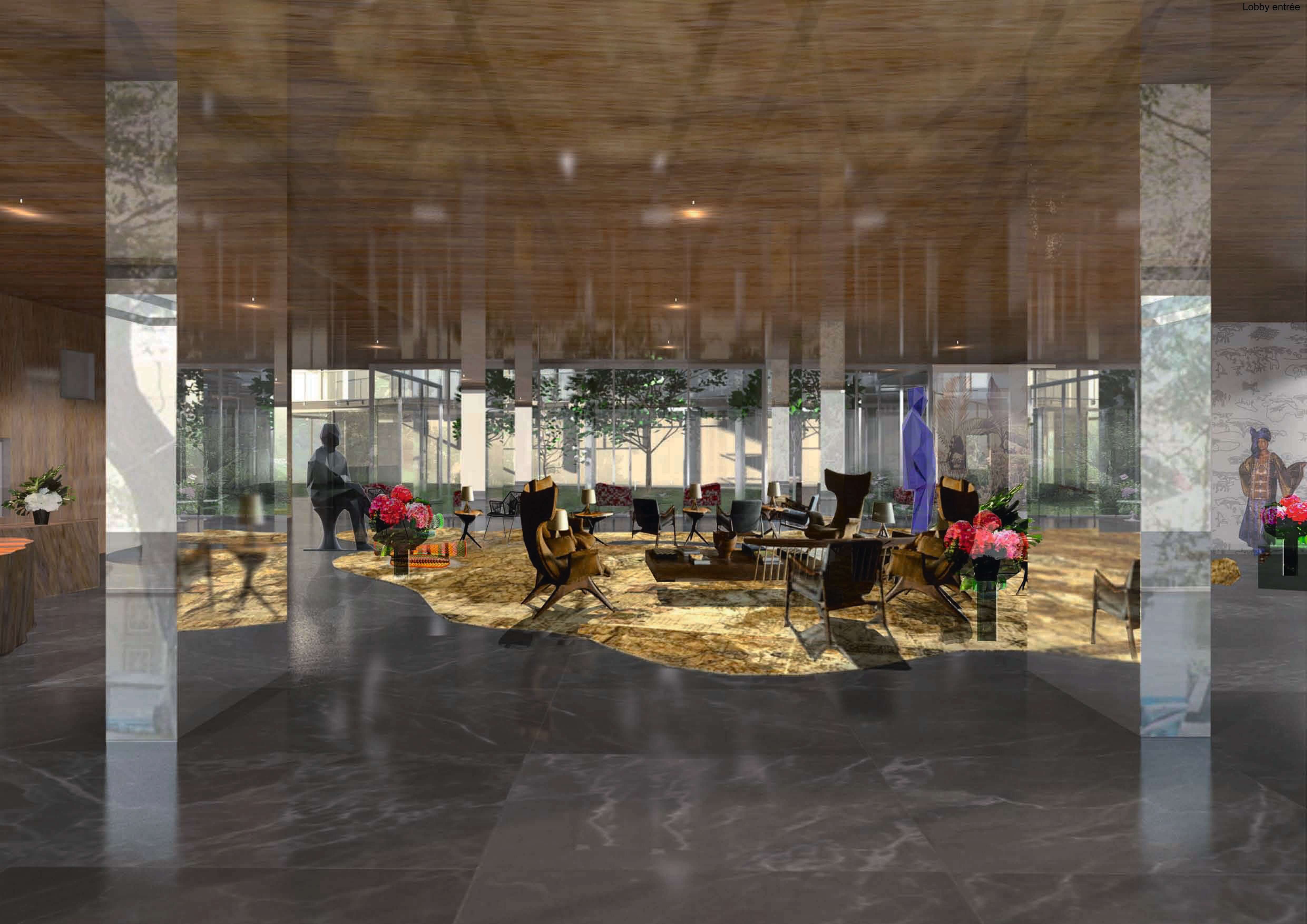
The hotel has 158 rooms, a fitness centre and an event centre. It is in the middle of downtown Dakar, at the edge of the “plateau”, a peninsula which used to be the colonial core of the city. The layout of the spaces challenges the traditional idea of luxury hospitality which relies on the array of sanitary features and the apparent quality of the details. This commercial, standardized approach seems reductive and simplistic here, especially given the character and richness of the context: the environment, the sea, the light are the real luxury here and are treated as materials for design. The rooms are wider than in traditional hotels. More than 98% of the façade is glazed, and a balcony extends the interior in order to take advantage of Dakar’s mild, evening breeze, while protecting from solar exposure. The resulting architecture is a device that makes the most of the view and maximizes the existing qualities.
The degree of involvement of the companies and the effort made by everyone who started the project have been outstanding, allowing all kinds of unexpected factors and difficulties to be overcome – different hotel brands, different
demands, administrative problems, technical issues…
It was in this extremely difficult yet still enthusiastic context that Jofebar joined an already ongoing project. Jofebar felt quickly moved by the potential of the location, the richness of the architecture to-be-built and the character of its developer. As a result, the company brought its savoir faire, its extraordinary craftsmanship but, more importantly, a great dose of resilience, work ethic and positivism. The fact that a project like this, despite all the difficulties, has been able to engage and motivate such a ground-breaking company is further proof of its out-of-the-ordinary nature.
Unluckily, as in every good story, chances are that it comes to a bitter end. The natural tendency of modern times to override these particularities – these eccentricities – is too important. To fight them and to counter them demands a high level of tenacity that, after almost five years of resistance, becomes more and more difficult to achieve.
It has, however, been a fascinating and enriching life-changing experience.
Mahmoud, Anne, Jean-Philippe, André, Sylvain, Bartolo, Ana, Khaori, Monica, Lucien, Bachir, Richard, Pedro, Tiago, Amandio, Côme, Abdulaye, Réda, Lara, Paulin, Khadim, Fréderic, Jeanne, Philippe B., Erwan, Remy, Armel, Rui, Avelino, Yacine, Adrian, Gonzalo, Gregoire, Daouda, Bathily, Sow, Cheikh, Papis, Ma Absa, Arona, Mbaye… but also every single person who ever had anything to do with this project: you have shown me how important it is to keep the zest for building alive. To always remember that this is a collective process and it is important to keep it as it used to be: a generous, joyful act of love.
I do thank you, for your audacity and your courage.
May this text serve as a reminder of what we have achieved – and not what we sadly missed.




Location Dakar, Senegal
Client Private
Project date 2006
Completion 2017
Architecture Lacaton & Vassal
Authors Anne Lacaton, Jean Philippe Vassal with Marcos García Rojo
Collaborators Bártolo Santos, Adrian Alvarez, Ana Fernández, Kaori Pedrazzoli, Emmanuelle Delage
Local architect Atelier d’architecture Réda Sleiman, assisted by Lara Bretones, Monica Rodriguez
Interior design Frédéric Druot, Jeanne Gerbeaud; Frédéric Druot Architecture
Structure E.TE.C.S, Lucien Santolini
Services Solutech / CEFI Dakar
Acoustics Gui Jourdan
Works supervision André Poretti